
Docudrama series: Hitler and the Nazis: Evil on Trial.
This six-part docudrama series, Hitler and the Nazis: Evil on Trial, available on Netflix, offers a comprehensive look at the Third Reich. It structures the narrative around the Nuremberg Trials and draws on rare audio, archival footage, and the historical reporting of William L. Shirer, including his book The Rise and Fall of the Third Reich.
The series uses the Nuremberg Trials as its narrative framework and follows the surviving Nazi leaders brought before the court in 1945 and 1946. Men like Hermann Göring, Rudolf Hess, and Joachim von Ribbentrop, along with military commanders and administrators, all pleaded “not guilty.” Using the trials as its theme, the documentary explores the history that led to them. The series is well-made and factual. Historians provide context for the events. It is informative and worth watching, but not fast-paced.
The series is historical, but watching it invites viewers to compare these events with developments unfolding around the world today. History repeats itself with a different face. It’s a record of how authoritarian leaders and fascist governments come to power. When you compare Hitler to subsequent authoritarians and dictators, you find similarities in their tactics. All differ to some degree, but they share tactics such as using the ballot box when possible, propaganda, and violence to rise to power and to try to hold on to it.
Although circumstances change, the methods remain remarkably consistent. The series shows how Hitler engaged people who felt disenfranchised during the German Weimar Republic, even as others enjoyed middle-class life. It also shows how he became what we might call a cult leader, even while imprisoned for six months. We learn how authoritarians identify scapegoats for real or imagined issues within the culture. The tactics take different forms, but they are always similar. One of the series’ most important lessons is that authoritarian movements often emerge through existing democratic institutions rather than through sudden military takeovers.
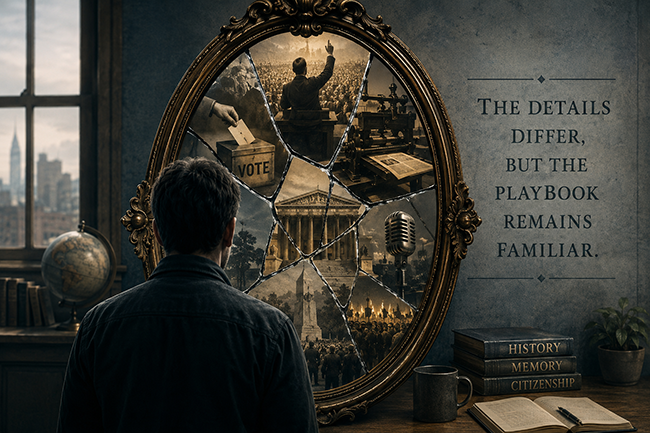
The value of studying Nazi Germany is not that history repeats itself exactly. It does not. Economic conditions, technologies, cultures, and political systems change. What repeats are recognizable patterns: leaders who claim only they can solve national problems, movements that identify enemies within, attacks on independent institutions, propaganda designed to replace debate with emotion, and the gradual normalization of political intimidation. The details differ, but the playbook remains familiar.
The danger is not that modern societies will suddenly become Nazi Germany. The danger is that citizens grow accustomed to small changes that seem temporary or harmless when viewed in isolation. Democratic institutions rarely disappear overnight. More often, they weaken gradually as the public accepts attacks on the press, the courts, political opponents, or established norms. By the time the threat becomes obvious, reversing course is far more difficult.
One tried-and-true tactic for creating the authoritarian leader’s myth is to spread his likeness everywhere. Photographs depict him as a deity or a strongman. Monuments. His name on buildings and in documents. An authoritarian leader portraying himself as part of the country’s ethos. Hitler, with Goebbels’s help, did all these things. The classic propaganda documentary, Leni Riefenstahl’s Triumph of the Will (1935), depicted Hitler’s airplane carrying him like a god from the clouds and landing at the 1934 Nazi Party Congress in Nuremberg. He made it a practice, even in those early days of air travel, to fly to events. He posed for all sorts of photographs (selfies) of himself in various poses that could be used or released to the press.
Episodes of the series reveal the circumstances that led to the rise of fascism and the Nazi Party’s ascent to power and eventual war. Similar patterns appear throughout the world today; even if they don’t match exactly, they often seem to be moving in the same direction. Present-day authoritarian leaders exist at different stages of their control. Some are rising to power while others are on the decline. A few are too clumsy in their power grabs or face strong resistance. Understanding history reveals the authoritarian playbook and helps prevent the repetition of the worst aspects of fascism.
Episode 1. Origin of Evil — Hitler’s turbulent childhood in Austria lays the groundwork for strong political ambitions. The end of WWI ushers in a fraught new era for Germany.
Episode 2. The Third Reich Rises — Using his public persona and loyal following, Hitler works to establish Germany as a global power amid widespread violence.
Episode 3. Hitler in Power — Nazi propaganda runs rampant as Hitler introduces a series of laws targeting Jewish people and brings his homeland, Austria, into the Third Reich.
Episode 4. The Road to Ruin — Driven by power and hatred, a determined Hitler sets out to expand German territory, fueling further conquests and the construction of concentration camps.
Episode 5. Crimes Against Humanity — With Hitler commanding the German armed forces, the Nazis invaded the Soviet Union, leading to mass murder and the horrors of the Holocaust.
Episode 6. The Reckoning — After the tide turns against Nazi Germany, the Allied powers seek to hold Hitler and other party leaders accountable for their crimes during the Nuremberg trials.
The series uses the docudrama format, combining expert commentary with dramatic reenactments. It also makes effective use of archival footage from that period. The film footage appears to be colorized archival black-and-white footage from the time. Color reenactment scenes are used subtly where appropriate. This approach allows viewers to engage with historical events on both intellectual and emotional levels. Historians provide context and interpretation, while actors bring historical figures and events to life. The docudrama format is especially useful for examining issues that still resonate today. By combining historical analysis with dramatic storytelling, these productions encourage viewers to see historical figures not as distant icons but as people confronting political and social forces that continue to shape societies around the world.
Readers interested in how authoritarian leaders build and maintain power may enjoy my satirical book, Dictatorship 101: Authoritarian Leadership Skills for Beginners, which examines many of the same tactics with humor and political satire. Amazon: https://www.amazon.com/dp/B0FP5DZZ94 and everywhere books are sold.