
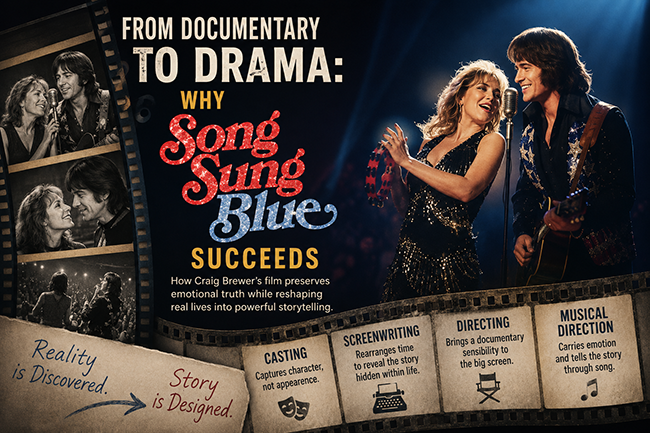
How Craig Brewer transformed a remarkable documentary into an equally compelling dramatic film.
Song Sun Blue (2025) 2hr 13m -Now Streaming on Netflix
Mike and Claire Sardina are a working-class couple from Milwaukee who perform as “Lightning and Thunder,” a Neil Diamond tribute band. Their lives were the subject of Greg Kohs’ 2008 documentary, Song Sung Blue. Seventeen years later, writer-director Craig Brewer adapted the documentary into a theatrical feature starring Hugh Jackman and Kate Hudson.
Adapting a documentary into a dramatic feature poses a unique challenge. How do filmmakers preserve the emotional truth of real people while reshaping their lives into compelling cinema? Song Sung Blue succeeds remarkably well. After watching the feature, I returned to the original documentary to understand why the transition from documentary to drama works so effectively.
The Theatrical Adaptation (2025)
Brewer’s Song Sung Blue dramatizes the extraordinary real-life story of Mike and Claire Sardina. In the late ‘80s, while forming the Neil Diamond tribute band Lightning and Thunder, the two fell in love and married. Following the couple through hard times and stage successes, the film chronicles how they never let go of their love for each other or for Neil Diamond.
Casting
Hugh Jackman (as Mike Sardina) and Kate Hudson (as Claire Sardina) truly capture the essence of their real-life counterparts. They create a love story that feels natural and real as the couple endures hardships and celebrates their vocations. This is a key aspect of the documentary version. The theatrical version of this story deals with the facts of the Sardina legacy and their family in a way that preserves truth and tells a great story.
Brewer doesn’t try to match the Sardinas’ full physical appearance. Instead, he casts actors who embody their personalities. Hugh Jackman bears little physical resemblance to the real Mike Sardina. Yet within minutes, those differences become irrelevant because he captures Mike’s humor, vulnerability, determination, and warmth. Great casting captures character rather than appearance. The achievement of Song Sung Blue is that, beneath the polish of a theatrical production, Mike and Claire never stop feeling like the vulnerable, working-class couple seen in Greg Kohs’ documentary.
Feature films naturally amplify their subjects. Charismatic actors, expressive cinematography, carefully crafted performances, and a musical score heighten the emotional experience. The challenge for Brewer and his cast is to harness those cinematic strengths without losing the ordinary humanity that makes Mike and Claire Sardina so compelling in the documentary. Song Sung Blue succeeds because its performances remain grounded in recognizable people rather than in idealized heroes.
The same principles apply to biographies, memoirs, and films based on historical events. Whether the source is a documentary, a personal memoir, or a writer’s own experiences, audiences expect authenticity without demanding strict chronology. The challenge is always the same: preserve the truth of the people while creating a dramatic structure that allows viewers to experience that truth emotionally.
Screenwriting the Adaptation
Writing a screenplay and making a theatrical film based on the real-life story originally presented as a documentary is a special task.
How can the transition from documentary reality to theatrical fiction be made while preserving the documentary’s established actuality? One of the screenwriter’s goals must be to preserve the emotional truth and the recognizable character revealed in the documentary. The real people portrayed in the documentary serve as the foundation for fictional characters who retain their human reality.
This feels different from adapting a work of fiction to the screen. Storytelling for documentaries and fiction films must have a structure that engages the audience, with a beginning, middle, and end. But the theatrical version must incorporate structure that addresses conflict, acting, and on-screen storytelling techniques in a fictional format. The documentary must share some of that structure, but real people perform differently from actors. The documentary relies on actual material, events as they happen, and recorded material. The fictional adaptation relies on the scriptwriter, director, and actors’ interpretations of facts, people, and events.
Reality is Discovered. Story is Designed.
A documentary discovers the story within reality. A screenplay designs a dramatic structure that reveals the same story. One of the screenplay’s smartest decisions is to avoid the documentary’s chronology. Rather than simply recreating events in the order they occurred in the documentary, Brewer reorganizes time to build stronger dramatic momentum. Scenes are repositioned, relationships are introduced earlier, and emotional turning points are placed for maximum impact. The result is not a distortion of the Sardinas’ lives but a clearer expression of what their story means. Documentary audiences expect chronology because they are watching history unfold. Fiction audiences expect narrative design. The screenwriter understands that distinction.
Viewing each version of the story is a distinct experience with different expectations. The fiction version focuses on the main characters’ spirits and how they deal with, and sometimes overcome, hardship. It strives to capture the essence of consequential moments in the characters’ lives. It highlights their inner thoughts and character, not necessarily revealed in the documentary. Audiences watching a documentary film have different expectations than those watching a theatrical film, even when the latter is based on a true story.
The documentary shows reality as it happens, but does not go beyond what we can see as the camera records it. Modern documentaries often interpret reality through editing, narration, structure, music, and point of view. While documentaries inevitably shape reality through editing and structure, they generally stop short of dramatizing thoughts, conversations, or private moments that were never recorded. Fiction films have the freedom to imagine those moments while remaining faithful to the larger truths established by the documentary.
Whether adapting a documentary or writing a screenplay based on one’s own experiences, the storyteller faces the same challenge. Real life rarely unfolds in the dramatic shape audiences expect. Important events may occur years apart, conversations take place in different settings, and turning points often reveal their significance only in hindsight.
In this adaptation, the screenwriter’s task is not to reproduce life exactly as it happened but to uncover the story hidden within it. Rearranging the chronology, combining events, or compressing time can strengthen the narrative, provided those choices preserve the lived experience of the people and events that inspired it.
Directing the Adaptation
Once the screenplay establishes the story’s structure, the director faces an equally important challenge: translating emotional authenticity into images, performances, and atmosphere. Both documentary and fiction films have the license to shape reality through cinematic techniques, editing, and acting to tell their stories. The story unfolds in 90s Milwaukee, Wisconsin. Brewer and his creative team ensure the film retains the look and feel of working-class Milwaukee by using local locations and having all actors adopt regional accents and speech patterns. Perhaps because of its documentary roots—or perhaps by deliberate design—the theatrical version retains a subtle documentary sensibility. Its naturalistic performances, understated cinematography, location shooting, and restrained visual style often make scenes feel observed rather than staged. That approach reinforces the authenticity of Mike and Claire’s relationship and keeps the film grounded even as it embraces the dramatic strengths of theatrical storytelling.
Musical Direction
Lightning and Thunder are the names Mike and Claire use for their interpretation of Neil Diamond’s work. The musical side of the production is crucial to getting it right, and composer Scott Bomar was instrumental in making that happen. The music and performance carry the film at every turn.
In a Focus Features News interview, Bomar was asked, “The film is an emotional roller coaster. How did you handle that in the score?”
“That was tricky because there is so much music in the film, and Kate and Hugh’s performances are so strong. I felt the score needed to be understated and subtle. We all felt we didn’t have to pummel the audience with the score. We just wanted to hint at things and let the music be a little subliminal.”
A Successful Adaptation
The best adaptations don’t ask, “Did this happen exactly this way?” They ask, “Does this reveal the same truth about these people?” When the answer is yes, audiences rarely object to a rearranged timeline. They recognize that dramatic structure can illuminate reality rather than diminish it.
The best storytelling reveals people rather than merely recording events. Song Sung Blue succeeds by preserving that human core while reshaping reality into compelling drama. The film shows that adapting a documentary is not an exercise in reproducing life scene by scene. It is an exercise in preserving emotional truth while creating dramatic structure. When filmmakers understand that distinction, they honor both history and cinema.