
Three Docudrama Series Films that Illuminate America’s Past — and Present
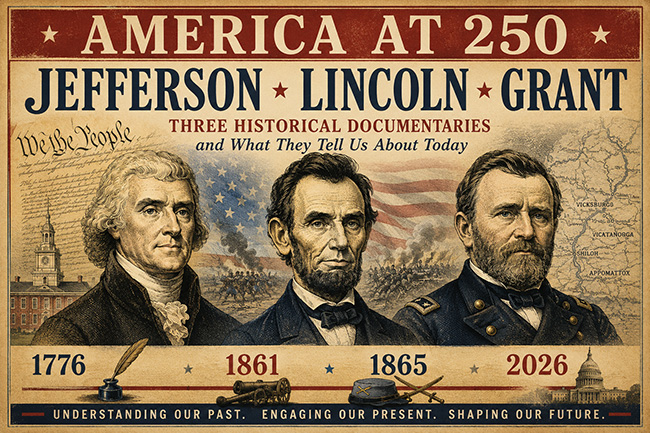
As the 250th Anniversary of the United States of America approaches, let’s look at three docudrama films I recently discovered on Netflix. I watched these multi-episode films: Abraham Lincoln, Ulysses S. Grant, and Thomas Jefferson. The first two films were more than biographies; Lincoln and Grant lived through the Civil War, so American history sets the stage. The Thomas Jefferson story begins in Colonial America, before the American Revolution, when the colonists rebelled against the King of the British Empire. These films helped me recognize historical patterns that continue to shape American history and politics today.
Three Historical Docudramas
Abraham Lincoln (2022): A three-part biographical documentary miniseries exploring his frontier childhood, his leadership of the military during the Civil War, and his legacy.
Grant (2020) is a three-part historical documentary miniseries that originally aired on the History Channel. The series is based on Ron Chernow’s bestselling biography, which chronicles the life of Ulysses S. Grant, from his rise from obscurity to leadership in the Civil War to his tenure as the 18th President.
The series blends dramatic reenactments featuring actor Justin Salinger with expert commentary from historians and authors. You can watch the miniseries and the other films directly on Netflix.
Thomas Jefferson (2025 Series): A 6-episode series from the History Channel that explores the Founding Father’s legacy, spanning his early life, presidency, and retirement. This insightful docudrama brings to light the complexities of colonial life and slavery, and how Jefferson and others lived with these issues.
Docudrama Format
All three productions use the docudrama format, combining expert commentary with dramatic reenactments. This approach allows viewers to engage with historical events on both an intellectual and emotional level. Historians provide context and interpretation, while actors bring historical figures and events to life. The docudrama format is especially useful when examining issues that still resonate today. By combining historical analysis with dramatic storytelling, these productions encourage viewers to see historical figures not as distant icons but as people confronting challenges that continue to shape American society.
Watching the Films
The Lincoln and Grant films took me back about 160 years to a time that, in relative terms, is not so long ago, especially with the country’s 250th anniversary coming up. After watching these two films, I found that the Jefferson series helped me better understand how we got to the Civil War. Together, these three historical docudramas have given me new insight into where we are today.
Watching Thomas Jefferson grow up in a wealthy, slaveholding family, with a companion slave assigned to him when both were around two years old, reveals much about life in colonial Virginia. In 1760, at 16, he attended the College of William and Mary, which offers insight into life at the time. It made me aware that it is important to understand where this United States began and on what foundation it rests. It occurred to me that what happened in 1776 inevitably led to the Civil War and is linked to the decisions Lincoln and Grant made in their time. The nation we inhabit 250 years later grew directly from those earlier choices and conflicts.
The Abraham Lincoln documentary focuses on Lincoln’s life and leadership during the nation’s greatest crisis. The Grant series complements that story by showing how Ulysses S. Grant became the general Lincoln came to trust in the struggle to preserve the Union. While Lincoln provides the political and moral leadership of the Civil War, Grant’s biography offers a broader view of the conflict in the western theater and shows how his persistence and strategic thinking helped secure key victories. Together, the two films reveal how leadership, military command, and political resolve shaped the war’s outcome.
Together, the Lincoln and Grant documentaries explain how the Civil War unfolded. The Jefferson series steps further back in time and explores the ideas, contradictions, and institutions that made that conflict possible in the first place.
What struck me most while watching these three productions was not merely the historical information they contained. It was how often the issues they explored—power, citizenship, race, inequality, rebellion, and democracy—echoed contemporary debates. History may not repeat itself exactly, but these films reminded me that many of today’s political conflicts have deep roots in the American past.
Key Issue in the Economy of the Colonies
Historians and politicians have often minimized the role slavery played from the founding of the North American colonies through independence, the Civil War, and to this day. In colonial times and after the Revolution, slaves were property. Most slaves were African. Slavery existed in all thirteen colonies and remained embedded in the young nation even as some northern states began gradual emancipation. The economy of the southern states was based on slave labor and land ownership.
Thomas Jefferson wrote The Declaration of Independence. The film reveals that he and the other founders were in revolt against a tyrannical King whom many believed was mentally ill. The King and the British Parliament regarded the colonies as property. To quell the rebellion, the King sent 30,000 troops to Massachusetts. They could arrest anyone suspected of rebellion as a traitor and enter and take any home to lodge troops. Watching the King’s reaction to colonial demands reminded me how often governments respond to dissent by expanding executive authority and relying on military power. Contemporary debates over immigration enforcement, citizenship, and presidential authority suggest that these questions remain far from settled.
Divisions
The sectional divisions that produced the Civil War never disappeared completely. Today’s political map often reveals regional patterns that trace back to the nineteenth century. Debates over voting access, civil rights, federal authority, and racial equality continue to reflect unresolved tensions rooted in that earlier era.
When Barack Obama, a biracial man recognized as a black man, was elected President twice, many Americans believed that the culture had evolved enough to overcome the racism imprinted since the country’s beginnings. Yet the reaction to Obama’s presidency, including the treatment he received from many political opponents, suggested that deeper historical divisions remained unresolved.
Perhaps if we learn more about how we, as a country and culture, evolved to this point in history, we can begin to resolve issues that arose when early versions of enlightenment lacked scientific and experiential data. Thomas Jefferson considered himself enlightened, but he was never able to abolish slavery. He fathered children with a half-white slave after his wife passed away. The slave was his wife’s half-sister. She became his mistress for 40 years. Jefferson wrote in the Declaration of Independence that all men were created equal. This literally did not include women or black slaves.
While writing this article, a breaking-news alert appeared on my phone: “Hegseth Strikes Female and Black Navy Officers from Promotion List” (6/1/2026 NYT). The headline served as a reminder that debates over race, equality, gender, power, and citizenship remain central to American life. The questions raised by Jefferson, Lincoln, and Grant are not confined to history books. They continue to shape the present.
History does not solve contemporary problems for us. It does, however, help us understand how we arrived here. These three docudramas remind us that today’s conflicts did not emerge overnight. To address them, we must first understand the long and often uncomfortable history that produced them.